

Board Performance · 2025
In this section14 topics
- Prevention of Conflicts of Interest3 items
- Prevention of the Use of Inside Information3 items
- Anti-Corruption4 items
- Whistleblowing3 items
- Selection of Directors & Chief Executives5 items
- Selection of Independent Directors2 items
- Director Development1 item
- Evaluation of Board & Subcommittee Performance3 items
- Subcommittees1 item
- Meeting Attendance & Remuneration3 items
- Supervision of Subsidiaries & Associated Companies4 items
- Board Duty Performance — Overview1 item
- Audit Committee Duty Performance1 item
- Executive Committee Duty Performance1 item
Prevention of Conflicts of Interest
Has the Company Acted to Prevent Conflicts of Interest?
Yes
Operations in the Past Year
The Board of Directors has established policies, criteria, and procedures for reporting the interests of directors and executives. Directors and executives are required to disclose any interests that may result in a conflict of interest with the Company. In this regard, directors and executives who have a vested interest in any matter or transaction that the Company is considering are prohibited from participating in the review or approval of such matters. In the year 2025, there were no instances in which any director, executive, employee, or representative of the Company acted in violation of the Company’s announced policies or guidelines.
Number of Conflict-of-Interest Cases
| Metric | Current Year | Previous Year | Two Years Ago |
|---|---|---|---|
| Total number of cases or issues related to conflicts of interest (cases) | 0 | 0 | 0 |
Prevention of the Use of Inside Information
Has the Company Acted to Prevent the Use of Inside Information?
Yes
Operations in the Past Year
The Company places great importance on managing the use of inside information in accordance with good corporate governance principles, firmly upholding integrity and ethical conduct in business operations. To ensure that investors receive accurate, reliable and timely information on an equal basis, the Company has established internal regulations concerning the use of inside information and the trading of securities by directors, executives, and employees, in alignment with relevant securities laws. These measures emphasize transparency in business operations. The key elements are summarized as follows:
Directors, executives, and employees of the Company who have access to such information must not use the Company’s financial or internal information—particularly material information that may affect the price of the Company’s securities and has not yet been disclosed to the public or the Stock Exchange of Thailand—for the purpose of trading the Company’s securities for their own benefit or for the benefit of others. They are required to avoid or refrain from trading the Company’s securities during the one-month period prior to the public disclosure of financial statements and for at least two business days after such information has been made publicly available.
The Company has a duty to disclose material operational information to the public promptly and broadly through the channels and methods prescribed by the Stock Exchange of Thailand and the Company’s disclosure policy. In addition, information is disseminated through other channels managed by the Investor Relations and Public Relations departments to ensure that all groups of investors have timely and equal access to the Company’s information.
The Company enforces strict regulations regarding computer system and information security to prevent the disclosure of sensitive information. Access to undisclosed internal information is strictly limited to only those who are responsible and directly involved, including personnel from the Accounting and Finance Department, Investor Relations Department, and Corporate Governance Department.
In the event of a violation of the aforementioned regulations, the Company will take disciplinary action as deemed appropriate for the case. This may include verbal warnings, written warnings, wage deductions, suspension from work, dismissal without severance pay, or legal proceedings.
In 2025, the Company’s monitoring results concerning the use of insider information for personal benefit, in accordance with the established policy, indicated that no violations were committed by the Company’s directors, executives, or employees. The Company strictly complied with the stated policy and ensured full adherence to all related measures. For example, the Company consistently disclosed material operational information to the public and all groups of investors promptly and equitably through the channels and methods prescribed by the Stock Exchange of Thailand
Number of Inside-Information Cases
| Metric | Current Year | Previous Year | Two Years Ago |
|---|---|---|---|
| Total number of cases or issues related to the use of inside information to seek benefits (cases) | 0 | 0 | 0 |
Anti-Corruption
Has the Company Acted on Anti-Corruption?
Yes
Operations in the Past Year
The Company conducts its business with a strong commitment to anti-corruption, upholding integrity, ethics, transparency, and accountability to all stakeholders. The Company has established guidelines for proper conduct for the Board of Directors, management, and employees in accordance with the Business Ethics and Employee Code of Conduct, which are integral parts of the Company’s Corporate Governance framework. Corruption is defined as “any act or omission in the performance of duties or misuse of authority in office, in violation of laws, ethics, regulations, or company policies, for the purpose of seeking undue benefits. This includes, but is not limited to, requesting, accepting, offering, or giving assets or other advantages to government officials or any individuals doing business with the Company.”
In addition, the Company has established an anti-corruption policy to serve as a practical guideline as follows:
Directors, executives, and employees must not engage in or support any form of corruption, under any circumstances, and must strictly comply with the Company’s anti-corruption measures.
Directors, executives, and employees are responsible for adhering to the good corporate governance policy and the anti-corruption policy. The Board of Directors has assigned the management to communicate and implement the anti-corruption measures throughout the organization.
Promote an organizational culture of integrity and commitment to fairness.
Provide training for employees within the organization to encourage honesty and integrity in the performance of their duties, and to ensure they apply the principles and code of conduct outlined in the corporate governance policy rigorously across all levels of the Company.
The Company has established a personnel management process that reflects its commitment to anti-corruption measures, encompassing recruitment, training, performance evaluation, compensation, and promotion.
The Company conducts internal audits to ensure the effectiveness of its internal control system in achieving organizational objectives. These audits also verify that all departments operate in accordance with regulations and policies, identify any deficiencies or weaknesses, and provide recommendations for improving operational efficiency and effectiveness in line with good corporate governance practices.
The Company cooperates with government authorities by requiring all parties entering into contracts with government agencies to disclose their income and expense statements to the Office of the National Anti-Corruption Commission (NACC).
The Company assigns the Company Secretary and the Internal Audit Manager as key personnel responsible for ensuring adherence to good corporate governance practices.
The Company has joined the Thailand's Private Sector Collective Action Coalition Against Corruption (CAC) and is committed to promoting transparency within the organization. The Company has established a working team on anti-corruption to oversee related activities. The Company has duly submitted its application for CAC certification, which is currently under consideration by the CAC Council.
In 2025, the Company’s operations in preventing any involvement in corruption by the Company and its subsidiaries were actively pursued. Relevant departments were required to identify and assess corruption-related risks as part of the Company’s risk management process, with regular reporting in place. Additionally, the Company established reporting channels to encourage employees to monitor and report any suspected bribery or corrupt practices.
Form of Anti-Corruption Operations
| Operation |
|---|
| The participation in anti-corruption projects |
| Communication and training for employees on anti-corruption policy and guidelines |
Number of Corruption Cases
| Metric | Current Year | Previous Year | Two Years Ago |
|---|---|---|---|
| Total number of cases or issues related to corruption (cases) | 0 | 0 | 0 |
Whistleblowing
Has the Company Implemented Whistleblowing Procedures?
Yes
Operations in the Past Year
The Company provides opportunities for both internal and external stakeholders to report any misconduct or lodge complaints related to violations of ethics and business code of conduct, deficiencies in internal control systems, breaches or non-compliance with laws or the Company’s regulations, as well as incidents of corruption, fraud, or financial statement manipulation. The Company has established appropriate whistleblowing channels and a management system for handling such reports and complaints to ensure timely and effective responses. The intent of this policy is to:
To enable stakeholders or individuals who, in good faith, are aware of misconduct or suspect that any incident may be in violation of the law or the Company’s regulations, to report such misconduct or lodge complaints through the reporting channels established by the Company.
To ensure that the Company’s handling of whistleblowing or complaints is conducted in a structured, efficient, agile, and effective manner—supporting the Company’s sustainable and stable growth.
To ensure that directors, employees, and any persons acting on behalf of the Company conduct business ethically, transparently, fairly, and in a manner that is auditable.
To ensure that whistleblowers and any individuals who cooperate with the Company in good faith are provided with protection and are safeguarded from retaliation or unfair treatment resulting from the act of whistleblowing or submitting complaints.
The Company has established the following channels for reporting misconduct or submitting complaints:
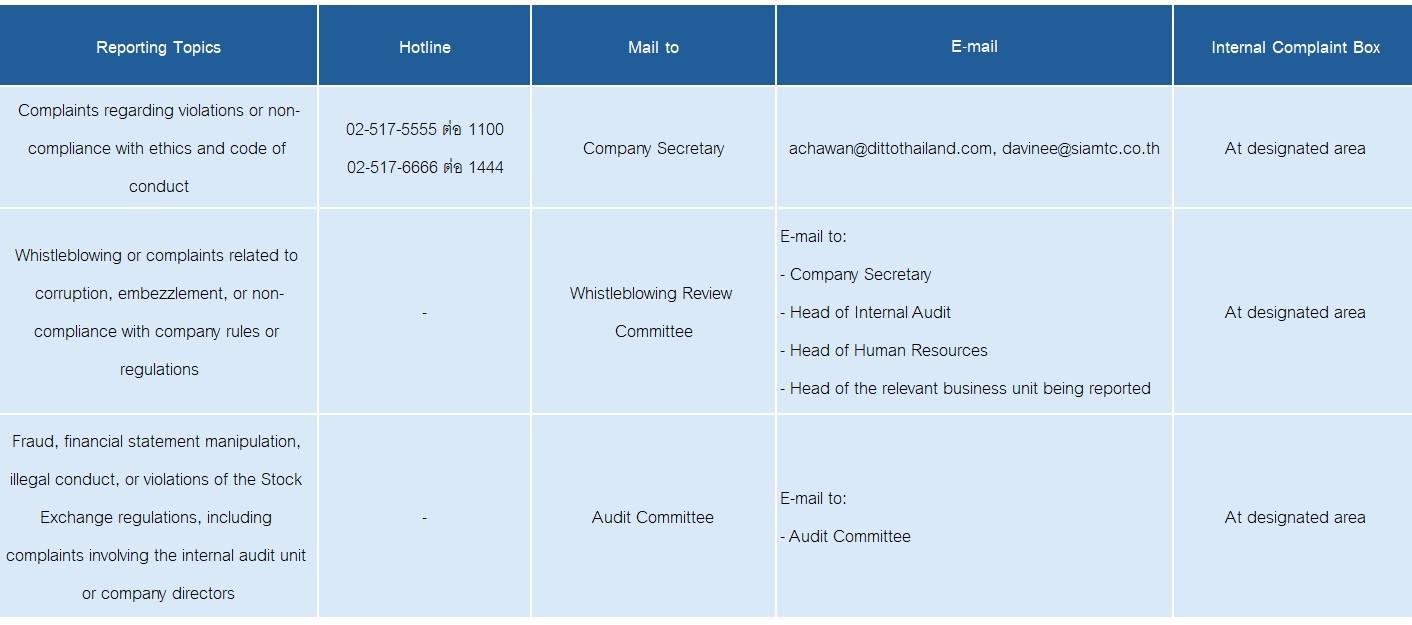
Note: In case of submitting a letter by mail, please send to: 235/1-3 Ratphattana Road, Ratphattana Subdistrict, Saphansung District, Bangkok 10240
In 2025, there were no whistleblower reports or complaints regarding incidents of corruption or violations of the company’s corporate governance policies and practices.
Number of Whistleblowing Cases
| Metric | Current Year | Previous Year | Two Years Ago |
|---|---|---|---|
| Total number of cases or issues received through whistleblowing channels (cases) | 0 | 0 | 0 |
Selection of Directors & Chief Executives
Selection, Development & Evaluation — Introduction
Directors’ and Executives’ Development
The Company supports directors, executives, and the Company Secretary in attending seminars and participating in continuous professional development programs, with the Company bearing the associated costs. Newly appointed directors are provided with an orientation program covering general information and an overview of the Company’s business operations, including key operational information and summaries of each business segment, organizational structure, operating results, and relevant rules and regulations. This is to ensure that directors are adequately informed prior to assuming their duties, enabling them to perform their roles and oversee the Company’s operations effectively.
Performance Evaluation of Directors
The Company conducts an annual performance evaluation of the Board of Directors, both on a collective basis and on an individual basis, as well as an evaluation of sub-committees on a collective basis, once a year. The evaluation criteria comprehensively cover the performance of directors’ duties. The Company Secretary is responsible for distributing the evaluation forms to all directors for completion, after which the results are compiled, summarized, and presented to the Board of Directors for acknowledgment.
Are Directors Selected Through the Nomination Committee?
Yes
Are Chief Executives Selected Through the Nomination Committee?
Yes
Rights of Minority Shareholders on Director Appointment
The Company provides minority shareholders with the opportunity to propose agenda items and nominate qualified individuals for election as directors in advance of the Annual General Meeting of Shareholders. The Company has set out the criteria and procedures for such proposals on its website www.dittothailand.com under Investor Relations>Shareholder Info>Shareholders’ Meeting, and has also announced the same through the Stock Exchange of Thailand’s information disclosure channels. In addition, the Company has provided standardized forms to facilitate shareholders in proposing agenda items and nominating candidates.
Method of Director Appointment
| Method |
|---|
| Method whereby each director requires approval votes more than half of the votes of attending shareholders with voting rights |
Selection of Independent Directors
Criteria for Selecting Independent Directors
Composition and Nomination of Independent Directors and the Audit Committee
The Audit Committee shall comprise at least three independent directors, each serving a term of three years. The Company has a policy for the nomination of audit committee members/independent directors, who must possess the following qualifications:
Holds no more than 1% of the total voting shares of the company, its parent company, subsidiaries, affiliates, major shareholders, or controlling persons of the company, including shares held by related persons.
Is not, and has not been, an executive director, employee, staff member, salaried advisor, or controlling person of the company, its parent company, subsidiaries, affiliates, or entities in the same level of subsidiaries, major shareholders, or controlling persons of the company, unless the person has ceased to have such characteristics for not less than two years before the appointment.
Has no blood relationship or legal relationship as a parent, spouse, sibling, or child, including the spouse of a child, with any executive, major shareholder, controlling person, or person to be nominated as an executive or controlling person of the company or its subsidiaries.
Has no business relationship or has never had any business relationship with the company, its parent company, subsidiaries, affiliates, major shareholders, or controlling persons in a manner that may interfere with their independent judgment, including not being or having been a significant shareholder or controlling person of entities with significant business relationships with the company, its parent company, subsidiaries, affiliates, major shareholders, or controlling persons, unless such relationship has ended at least two years prior to the appointment. Business relationships include transactions as defined in the Notification of the Capital Market Supervisory Board No. TorJor. 39/2559 Re: Application for and Approval of the Offering of Newly Issued Shares, dated 30 September 2016 (including any amendments).
Is not and has never been an auditor of the company, its parent company, subsidiaries, affiliates, major shareholders, or controlling persons, and must not be a significant shareholder, controlling person, or partner of the audit firm that employs the auditor of such entities, unless the relationship ended at least two years prior to the appointment.
Is not and has never been a professional service provider, including legal or financial advisors, who received service fees exceeding two million baht per year from the company, its parent company, subsidiaries, affiliates, major shareholders, or controlling persons, and must not be a significant shareholder, controlling person, or partner of such professional service provider, unless such relationship ended at least two years prior to the appointment.
Is not a director appointed as a representative of the company’s director, major shareholders, or shareholders related to the company’s major shareholders.
Does not operate a business of the same nature and in significant competition with the company or its subsidiaries, and must not be a significant partner in a partnership, or a director with management authority, employee, salaried advisor, or a shareholder holding more than 1% of the total voting shares in a company that operates a business of the same nature and in significant competition with the company or its subsidiaries.
Has no other characteristics that would hinder them from providing independent opinions on the company’s operations.
Is not a director assigned by the board of directors to make decisions on the business operations of the company, its parent company, subsidiaries, affiliates, or companies at the same subsidiary level, major shareholders, or controlling persons.
Is not a director of the parent company, subsidiary, or same-level subsidiary, specifically if they are a listed company on the Stock Exchange of Thailand.
Additionally, at least one independent director serving as a member of the audit committee must possess adequate knowledge and experience in accounting or finance to be able to review the credibility of the financial statements. The company also considers other qualifications, such as industry experience, specialized expertise relevant to the business, and ethical standards.
Did Any Independent Director Have a Business or Professional Relationship?
No
Director Development
Qualifications for Director Selection
| Qualification | Skill & Expertise |
|---|---|
| Knowledgeable in Digital Transformation and the use of technology to develop and transform organizations into digital enterprises, with an understanding of Green Technology. | 140 · Description: Information & Communication Technology · 150 · Description: IT Management · 152 · Description: Data Analysis · 164 · Description: Strategic Management · 265 · Description: Governance/ Compliance |
Evaluation of Board & Subcommittee Performance
Evaluation Criteria — Introduction
Performance Evaluation of Company Directors
The Company conducts an annual performance evaluation of the Board of Directors, both on a collective basis and on an individual basis, as well as an evaluation of sub-committees on a collective basis, once a year. The evaluation criteria comprehensively cover the performance of directors’ duties. The Company Secretary is responsible for distributing the evaluation forms to all directors for completion, after which the results are compiled, summarized, and presented to the Board of Directors for acknowledgment.
Criteria for Evaluating Board Performance
Evaluation Criteria for the Board of Directors
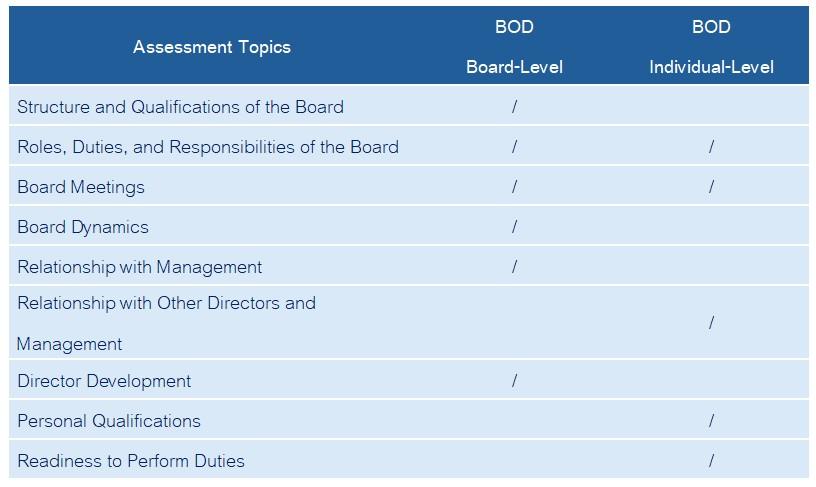
1. Topics for Individual Director Evaluation
Personal Qualifications:
To assess whether the director possesses suitable qualifications, knowledge, and expertise that are beneficial to corporate governance.
Readiness to Perform Duties:
To assess whether the director has sufficient knowledge and understanding of their roles, duties, and responsibilities, including the company’s business operations, nature of the business, core products, and stakeholder groups, as well as whether they stay regularly updated on developments that may impact the company.
Participation in Meetings:
To assess whether the director thoroughly reviews documents and relevant information necessary to perform their duties before and after meetings, provides useful input, and strictly complies with meeting regulations and protocols.
Roles, Duties, and Responsibilities:
To assess whether the director is dedicated and committed in fulfilling their duties, actively participates in key company activities, strictly adheres to the Board Charter and related rules and regulations, monitors management’s performance appropriately, and offers constructive suggestions.
Relationship with Other Directors and Management:
To assess whether the director maintains good working relationships with fellow board members and the management team.
2. Topics for Board-Level Evaluation
Structure and Qualifications of the Board:
To assess whether the number of directors is appropriate for the size and nature of the business. This includes consideration of the qualifications, composition, tenure, appointment of sub-committees, criteria for holding office, and other relevant aspects.
Roles, Duties, and Responsibilities of the Board:
To assess whether the Board dedicates sufficient time and attention to its duties, appropriately reviews relevant policies and principles, ensures transparency and clarity in the nomination and selection process of directors, and regularly follows up on management’s performance to ensure alignment with board policies, objectives, and resolutions.
Board Meetings:
To assess whether directors understand and comply with meeting regulations, are informed of the meeting schedule in advance to allow sufficient time to attend, whether the frequency and duration of meetings are appropriate, and whether directors receive meeting materials in advance with accurate, complete, and relevant information that facilitates sound decision-making.
Board Dynamics:
To assess whether each director attends meetings regularly, comes well-prepared with adequate knowledge of the issues, prioritizes agenda items appropriately, allocates sufficient time for discussions, expresses opinions freely, and poses thoughtful, challenging questions that support business development.
Relationship with Management:
To assess whether the Board provides open and direct opportunities for management to seek advice or consultation, and whether the Board demonstrates trust, respect, and confidence in management’s ability to perform its duties.
Director Development:
To assess whether directors understand their roles, duties, and responsibilities as board members, possess adequate knowledge and understanding of relevant laws and best practices, and whether the company provides proper orientation for new directors. It also includes ensuring that management delivers essential documents to help directors understand the business and their responsibilities, and encourages all directors to pursue continuous training and development to enhance their knowledge and skills.
Evaluation of Board Performance in the Past Year
Topics for Board of Directors Evaluation
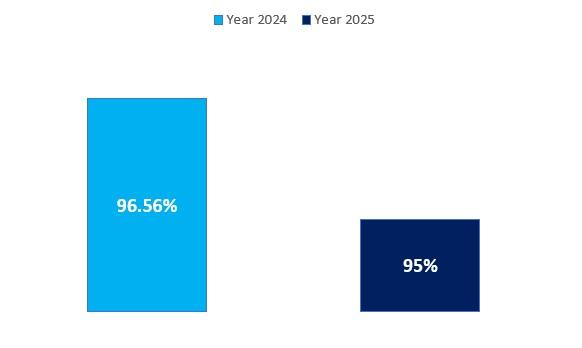
Board of Directors' Evaluation Results (Individual-Level)
In 2025, the average score was 95%, which is considered excellent.
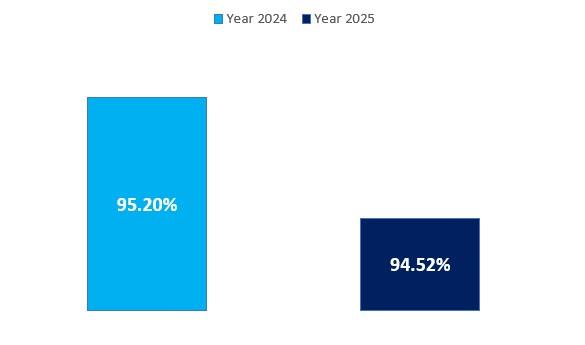
Board of Directors' Evaluation Results (Board-Level)
In 2025, the average score was 94.52%, which is considered excellent.
Summary of Subcommittee Performance Evaluation Results (by Committee)
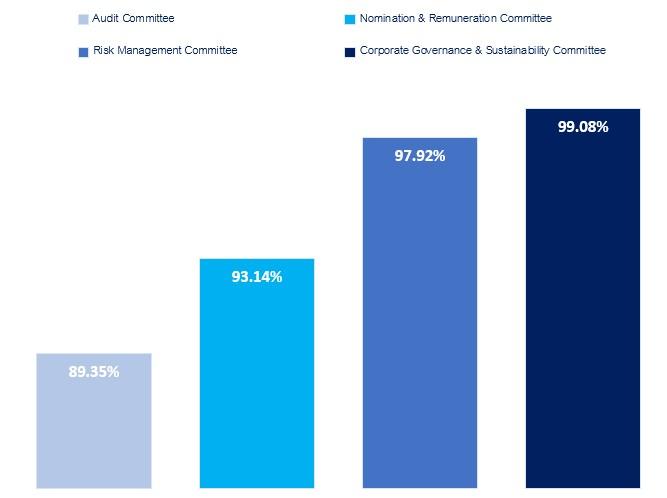
In 2025, the Company conducted performance evaluations of its subcommittees on a committee-by-committee basis. The results are as follows:
The Audit Committee achieved an average score of 89.35%.
The Nomination and Remuneration Committee achieved an average score of 93.14%.
The Risk Management Committee achieved an average score of 97.92%.
The Corporate Governance and Sustainability Committee achieved an average score of 99.08%.
Subcommittees
Subcommittees
| Results of the Subcommittee's Duty Performance |
|---|
Pursuant to the resolution of the Board of Directors of Ditto (Thailand) Public Company Limited, the Nomination and Remuneration Committee was duly appointed, comprising three members as follows:
In 2025, the Committee convened a total of one meeting. All members duly attended the meeting and discharged their duties with due care, prudence, independence, and transparency, in the best interests of the Company and its shareholders, and in accordance with the scope of authority, duties, and responsibilities as assigned. The material matters undertaken by the Committee are summarized as follows:
|
The Board of Directors has appointed the Corporate Governance and Sustainability Committee, comprising three directors, to be responsible for establishing and reviewing policies and guidelines in accordance with good corporate governance principles. This includes business ethics, anti-corruption measures, corporate social responsibility, environmental policies, climate change management, human rights, and other related policies to ensure sustainable business operations in the long term. In 2025, the Corporate Governance and Sustainability Committee convened a total of three meetings, with the following members:
In 2025, the Committee performed its duties by providing guidance and constructive recommendations on corporate governance and sustainability management in accordance with its defined scope, authority, and responsibilities. The key activities can be summarized as follows:
The Corporate Governance and Sustainability Committee plays a vital role in overseeing and driving the Company’s operations in line with good corporate governance principles and sustainable development practices. The Committee focuses on integrating environmental, social, and governance (ESG) considerations into business processes to promote stable growth, transparency, and long-term value creation for all stakeholders. As a result of continuous oversight and enhancement of sustainability practices, the Company achieved a SET ESG Rating of “AAA” in 2025 from the Stock Exchange of Thailand for the second consecutive year. In addition, the Company received an “Excellent” rating (5 stars) in the Corporate Governance Report of Thai Listed Companies (CGR 2025), assessed by the Thai Institute of Directors Association (Thai IOD), for the second consecutive year. This reflects the Company’s strong commitment to conducting business in accordance with good corporate governance principles, while comprehensively addressing environmental, social, and governance (ESG) impacts. |
Following the resolution of the Board of Directors at Meeting No. 2/2025 held on 15 May 2025 to appoint the Risk Management Committee, tasked with establishing the Company’s risk management policy and framework, the Risk Management Committee has duly performed its duties and responsibilities as assigned. This has been carried out in alignment with good corporate governance principles and the practices of leading listed companies in Thailand. In 2025, the Risk Management Committee convened a total of 3 meetings, with the following members:
The Risk Management Committee performed its duties in establishing directions and providing valuable recommendations for enterprise risk management, within the scope of its roles, authorities, and responsibilities as defined. The key highlights of the Committee’s performance can be summarized as follows:
|
The Strategic Committee was appointed pursuant to the resolution of the Board of Directors’ Meeting No. 6/2025 held on 22 December 2025, and no meeting of the Committee was convened within 2025. |
Meeting Attendance & Remuneration
Justification for Directors' Non-Attendance
-
Types of Remuneration of the Board of Directors
The Annual General Meeting of Shareholders for the year 2025, held on 25 April 2025, resolved to approve the establishment of remuneration for the Board of Directors and sub-committees for the year 2025 in the form of meeting allowances, as well as monthly remuneration for directors, with no other benefits provided. The details are as follows:
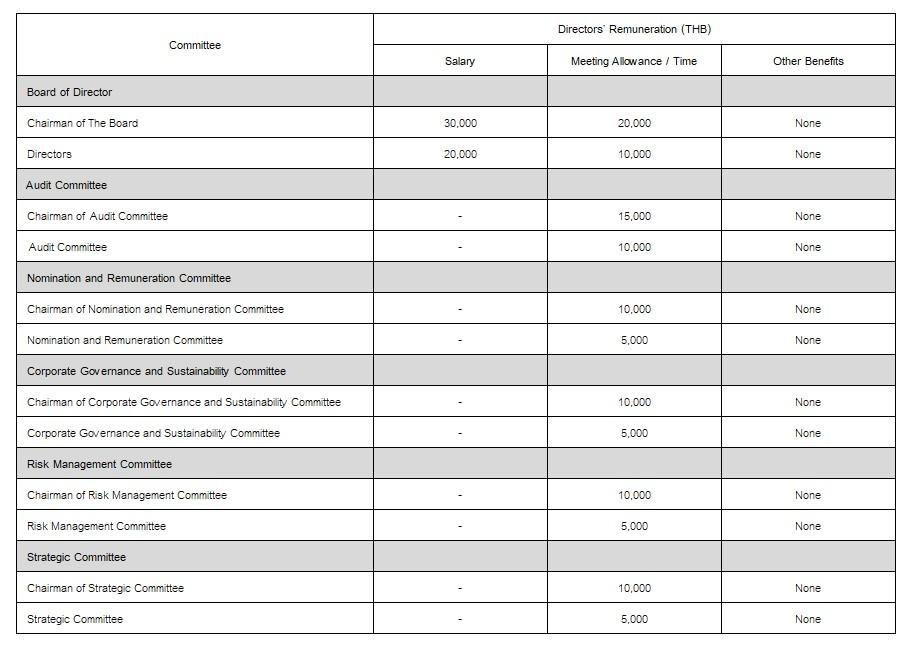
Remarks: Directors who are executives or employees of the Company and subsidiary are not entitled to receive the above remuneration
Remuneration or Benefits Payable to the Board
| Metric | Amount (Baht) |
|---|---|
| Remunerations or benefits pending payment to the board of directors over the past year (baht) | 0 |
Supervision of Subsidiaries & Associated Companies
Does the Company Have Subsidiaries or Associated Companies?
Yes
Is There a Mechanism for Overseeing Subsidiaries and Associated Companies?
Yes
Mechanism for Overseeing Management of Subsidiaries
The Company has established policies for investment in and management of its subsidiaries and associated companies. Investments are made in businesses that are related, aligned with, or beneficial to its operations, in order to strengthen the Company’s stability and overall performance.
In considering any investment, the Company evaluates the proportion of investment, expected returns, potential risks, and the Company's financial position. All investments decision must be approved from the Board of Directors’ meeting or the shareholders’ meeting, as applicable, in accordance with the approved authorization framework.
In addition, for the governance of subsidiaries and associates, the Company considers appointing representatives with appropriate qualifications and experience relevant to the invested businesses, to serve as directors of subsidiaries and associates. This appointment is made in proportion to the Company’s shareholding or in accordance with mutual agreements in the case of associated companies. The Company also closely monitors the performance and operating results of its subsidiaries and associates continuously.
Oversight Mechanisms
| Mechanism |
|---|
| Sending representatives to act as directors, executives or controlling persons in proportion to shareholdings |
| Other important transactions |
| Acquisition or disposal of assets |
| Internal control system of the subsidiary operating the core business is appropriate and sufficient in the subsidiary operating the core business |
| Transactions between the Company and related persons |
| Disclosure of financial information and operating results |
| Defining the scope of powers, duties and responsibilities of directors and executives who represent the company in setting important policies |
Board Duty Performance — Overview
Board Duty Performance — Overall Description
The Board of Directors plays a vital role in setting policies and strategies to enhance the Company’s competitiveness and in overseeing management to ensure efficient operations that create value for investors. The Board has provided oversight and consideration on key matters in accordance with its roles and responsibilities as well as offered valuable insights that contribute to the development of the organization.
Audit Committee Duty Performance
Results of the Audit Committee's Duty Performance in the Past Year
Report on the Performance of Duties by the Audit Committee
The Audit Committee of Ditto (Thailand) Public Company Limited comprises independent directors who are qualified and experienced in accounting, finance, law, and other fields. They perform their duties as assigned by the Board of Directors, under a written charter prepared by the Audit Committee and approved by the Board of Directors, in accordance with international principles and the requirements of the Stock Exchange of Thailand.
The Audit Committee consists of 4 independent directors as follows:
Mr. Wuth Meechouay (Chairman of the Audit Committee)
Mr. Tawee Meengern (Audit Committee Member)
Professor Woothisarn Tanchai (Audit Committee Member)
Mr. Narong Dechathanarujikorn (Audit Committee Member)
In 2025, the Audit Committee held a total of 4 meetings. All Audit Committee members prioritized attending these meetings and conducted their deliberations with thoroughness, prudence, transparency, and independence, always considering the best interests of the Company and its shareholders, within the scope of their defined powers and responsibilities. Discussions were held with the internal audit department, internal auditors, and external auditors on relevant matters. The key aspects of their performance are summarized as follows:
1. Review of Financial Reports
The Audit Committee reviewed the quarterly financial statements and the annual financial statements for 2025 of Ditto (Thailand) Public Company Limited and its subsidiaries, including inter-company transactions and transactions that may involve conflicts of interest, in conjunction with management. The auditor was invited to attend the meetings for the consideration of the quarterly and annual financial statements for 2025. The Audit Committee discussed with the auditor the accuracy and completeness of the financial statements, significant accounting adjustments affecting the financial statements, the adequacy and appropriateness of accounting methods and audit scope, the accurate and sufficient disclosure of information, and the independence of the auditor. This was to ensure that the preparation of financial statements complied with legal requirements and accounting standards under generally accepted accounting principles, were reliable and timely, and included sufficient disclosure of information for the benefit of investors or financial statement users.
2. Oversight and Supervision of Internal Audit Work
The Audit Committee considered and approved the annual internal audit plan for 2025, as well as the budget to support its implementation. Furthermore, the Committee reviewed the performance of the internal audit department according to the plan, considered significant audit findings and recommendations, and monitored the implementation of corrective actions based on internal audit reports regarding material issues, with the aim of improving internal controls to be adequate and effective. The Audit Committee was satisfied with management's efforts in improving the systems and internal controls.
3. Review of the Effectiveness of Internal Control Systems
The Audit Committee reviewed and revised the internal control system in conjunction with the internal auditor and external auditor. In 2025, the Committee considered various operational aspects, including the prevention or reduction of errors, damages, or fraud, the reliability of financial reports, and compliance with relevant laws and regulations. Both the external auditor and the Company's internal auditor concurred that no significant deficiencies or issues were found.
4. Review of Risk Management
The Audit Committee reviewed the Company's risk management to ensure that management appropriately conducted risk management activities and considered various risk issues. This included regularly reviewing the suitability and effectiveness of risk management processes. In 2025, no significant issues or areas requiring improvement were identified.
5. Consideration of the Appointment of the Auditor for the Year 2026
The Audit Committee considered proposing the appointment of
Mr. Banjong Pichayaprasat, Certified Public Accountant No. 7147, or
Mr. Kraisit Silpamongkolkul, Certified Public Accountant No. 9429, or
Ms. Khemanant Jaichuen, Certified Public Accountant No. 8260, or
Ms. Sunisa Sema, Certified Public Accountant No. 7707, or
Ms. Kornpreeya Soonpipatsakul, Certified Public Accountant No. 10001
from Siam Truth Audit Co., Ltd. or other auditors within the same firm, to serve as the Company's auditor for the year 2026, including the consideration of audit fees. This proposal was submitted to the Board of Directors for consideration and subsequently presented for reporting and approval at the Annual General Meeting of Shareholders for 2026.
6. Review of Compliance with Relevant Regulations, Rules, and Laws
The Audit Committee, in conjunction with the Internal Audit Department, reviewed the Company's business-related operations to ensure compliance with the Securities and Exchange Act, regulations of the Stock Exchange of Thailand, and other relevant laws. This included a review of good corporate governance practices to foster transparency for investors, thereby building external confidence in the Company's business operations. The review aimed to ensure that the Company conducted its business in accordance with business conditions correctly and appropriately. In 2025, no instances were found where the Company and its subsidiaries acted in violation of relevant laws and regulations.
7. Consideration and Provision of Opinions on Related Party Transactions
The Audit Committee considered and provided opinions on related party transactions with the Company and its subsidiaries, reviewing the reasonableness of the transactions and ensuring that pricing conditions were in line with general market prices and trade terms, fair, and did not result in any transfer of benefits. This also included a review to ensure that the Company conducted related party transactions correctly and appropriately, in accordance with its inter-transaction policy and the regulations of the Securities and Exchange Commission and the Stock Exchange of Thailand.
The Audit Committee has exercised its knowledge, abilities, experience, due diligence, and sufficient independence in performing its duties and responsibilities as stipulated in the Audit Committee Charter approved by the Board of Directors. The Audit Committee has considered and is of the opinion that the Company's financial information reports are accurate, reliable, and in accordance with generally accepted accounting standards. The Company has appropriate internal control systems, adequate risk management, and operations that comply with good corporate governance principles, strictly adhering to relevant regulations, rules, and laws.
Executive Committee Duty Performance
Results of the Executive Committee's Duty Performance in the Past Year
The Board of Directors of Ditto (Thailand) Public Company Limited has appointed the Executive Committee, comprising five members, as follows:
Mr. Takorn Rattanakamolporn (Chairman of Executive Committee)
Mr. Chaithad Kulchokwanich (Executive Committee)
Ms. Pondkarn Rattanakamolporn (Executive Committee)
Mr. Chaiyuth Eiadkaew (Executive Committee)
Ms. Muttana Wicheankaewmanee (Executive Committee)
In 2025, the Executive Committee convened a total of 12 meetings. The Committee consistently demonstrated a strong commitment to meeting attendance and performed its duties with due care, prudence, and responsibility, taking into account the best interests of the Company, within the scope of its delegated authority and responsibilities.
The key duties and responsibilities performed by the Executive Committee are summarized as follows:
To consider and approve the Company’s operational targets, business plans, budget reviews, as well as policies and procedures relating to general business operations.
To manage the Company’s operations in accordance with its objectives and business directions.
To supervise and oversee the business operations of the Company and its subsidiaries to ensure alignment with established policies and strategies, including the authority to approve specific matters or transactions undertaken in the ordinary course of business.
To consider and approve capital expenditures and financial transactions with financial institutions, including the opening and closing of bank accounts, borrowings, and other related transactions in the normal course of business of the Company and its subsidiaries, within the prescribed approval limits.
To consider and approve employee welfare and corporate activities.
To consider and approve changes to the organizational structure at the departmental level.
To consider and approve participation in bidding for projects with contract values for sales and services in accordance with the Executive Committee’s approval authority.
To review and screen matters prior to submission to the Board of Directors for consideration, approval, or acknowledgment, as appropriate.